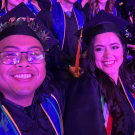
Odin Dailo’s professional path didn’t always point toward child welfare. But now, with a Title IV-E-funded M.S.W. in hand, he's helping to identify new strategies for building more resilient and supportive family systems.
As division chief of Family First Prevention Services with the Los Angeles County Department of Children and Family Services (LA DCFS), Tamara Hunter, D.S.W., is helping to tell a new story about child welfare in California.
As new research and legislation transform California's Mandated Reporting practices, Title IV-E educators are preparing their students for the future of child welfare practice.
By providing dedicated students with the financial support they need to access specialized child welfare training, Title IV-E helps emerging professionals build impactful careers that improve outcomes for children, youth and families.
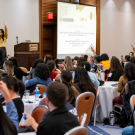
On April 24, 2026, Title IV-E Students and child welfare practitioners from across California gathered in Burlingame for the 2026 Title IV-E Summit. Across five breakout sessions and two plenary addresses, participants considered the theme, "Sustaining the Work: Building Well-Being for Families and Social Workers." Photos by Josimar King
Balancing personal well-being against workplace stress can be tricky in any profession. But in child welfare, where the job often means guiding families through some of the darkest moments of their lives, it can feel like a daily struggle. From managing complex case plans and child removal proceedings to responding to abuse and neglect, child welfare professionals face high risks of burnout, secondary traumatization and other serious stressors. Left unaddressed, these pressures can drive turnover and weaken workforce resilience.
As a child welfare social worker with Napa County’s Department of Children and Family Services and Title IV-E alumnus, Shirley “Kippi” Begay wakes up every day knowing that she has found work with purpose. A former Care Coordinator with the Native American Health Center in Oakland, Kippi, who is San Carlos Apache, Navajo, Hualapai and, by her own account, Urban Indian, helps to build brighter futures for Native children and families in her community.
Vania Buck is thinking big about the future of child welfare. “We’re facing a lot of challenges with retention and recruitment, and I think building new kinds of systemic support can really make an impact.” It’s a major task, but Vania isn’t intimidated. In fact, with a Title IV-E-funded Master of Social Work (MSW) under her belt, a doctorate in progress, and an innovative course on the books at Chico State, she’s already leading the charge.
Alumni story: How the Title IV-E Education Program empowers students to build lasting careers, connections and communities in child welfare—transforming futures while shaping California’s social work landscape.
One of the great strengths of the California Title IV-E Education program is its remarkable reach. With IV-E-supported Associates of Arts (A.A.), Bachelor of Social Work (B.A.S.W.) and Master of Social Work (M.S.W.) programs on offer at twenty colleges and universities across California, it’s a program that touches down in every kind of community and creates opportunities for every kind of student.
California’s child welfare workforce is predominantly comprised of passionate and committed individuals driven by a deep desire to change their communities for the better. Tasked with intervening in complex and distressing cases of abuse and neglect, however, these dedicated workers often experience compassion fatigue, secondary trauma and burnout as a part of their deep connection to the profession.
As in nearly all fields, digital tools of all stripes are now standard-issue in the world of social work and child welfare. But even as such tools offer tantalizing new efficiencies, they are in many ways a poor fit for the uncertainties and gray areas that make up the challenging reality of child welfare services.
The California Department of Social Services has announced a strategic partnership with UC Davis Human Services and UCLA Luskin School of Public Affairs to administer the California Title IV-E Education Program. This pivotal program provides critical education and support to undergraduate and graduate social work students committed to careers in public child welfare.